Changed surgical technique resulted in fewer bleedings and readmissions.
Patients experienced fewer major bleedings following tonsillectomies when the surgeons changed their technique. The number of patients who had to be readmitted or reoperated on consequently decreased.
Photo: Siri Wennberg, St. Olavs Hospital
The choice of surgical method and technique can have a positive effect for both patients and hospitals. This is demonstrated by a quality improvement project conducted by the Norwegian Quality Register for Ear, Nose, and Throat — the Tonsil Register.
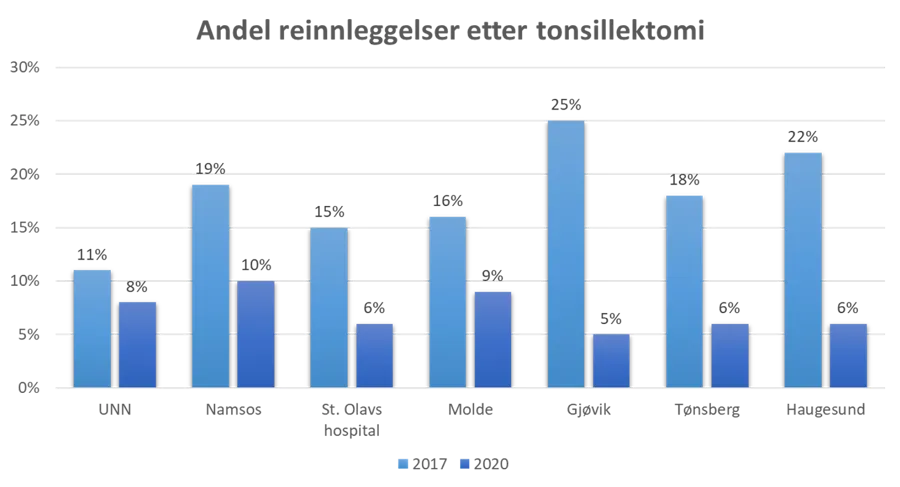
In the project, seven Norwegian hospital departments opted for a different method and technique for tonsil surgery. The result was a significant reduction in the number of readmissions due to severe bleeding among patients. One department reduced its readmission rate from 25 per cent in 2017 to just five per cent in 2020.
Awarded Improvement Prize
For this project, the Tonsil Register and the ENT department at St. Olav's Hospital recently received the Health Mid-Norway RHF Improvement Prize of 100,000 Norwegian kroner.
— The winning project is an exemplary example of quality improvement in practice. Based on known knowledge of risk and unwanted variation, the prize winners have implemented measures that have documented effects on quality and patient safety. They set clear outcome goals before starting and achieved excellent results, says the Managing Director of Health Mid-Norway RHF, Stig Slørdahl, in a video where he announces the winner.
Here you can watch the YouTube video of the 2021 Improvement Prize presentation.
— We who work with the Tonsil Register were very pleased to receive the prize in collaboration with the ENT department at St. Olav's Hospital. The work done demonstrates how a quality register can be used to improve treatment. There has been close and good cooperation throughout the project. All credit goes to those who have done the work in the clinic, says the head of the Tonsil Register, Siri Wennberg.
High Number of Readmissions Due to Bleeding
The seven hospital departments participated in the project because they had low achievement on the quality indicator “readmission due to bleeding”. Any readmission rate above 10 per cent is considered low achievement.
Data from the Tonsil Register in 2017 showed that there was a relatively high number of readmissions in Norwegian hospitals due to bleeding after tonsil surgeries (8%). There was also a very large variation between hospitals (0—25%).
Bleeding that occurs after surgery (postoperative bleeding) is understandably burdensome for patients. It can lead to them needing to be readmitted to hospital, and possibly even re-operated. There have also been cases of fatalities following such surgeries, although this is very rare. Additionally, many readmissions place extra demands on healthcare resources. The goal is therefore to keep the number of bleedings as low as possible.
Transitioned from “Hot” to “Cold” Surgical Technique
Tonsil surgeries are considered safe procedures. However, international research shows that the surgical technique chosen by surgeons has a significant impact on whether complications arise after the operation.
In terms of tonsil surgery, the change from so-called “hot” to “cold” technique has been important. The cold technique involves surgeons using cold instruments, such as knives or scissors. Those who operate with cold instruments have fewer readmissions than those who use hot instruments. The latter involves the use of heated instruments, such as diathermy scissors, bipolar diathermy forceps, and radiofrequency coblation.
At the seven hospital departments, surgeons transitioned from a hot technique to a cold technique. By the end of the project, these departments had, on average, reduced the number of readmissions due to bleeding from 14 per cent in 2017 to six per cent in 2020. A similar reduction has not been observed nationally.
Valuable Data in the Tonsil Register
The Tonsil Project shows that a quality register can be used to identify areas needing improvement. It can also be used to evaluate the effects of measures. A prerequisite for the success of this project has been the close collaboration between the register secretariat and the participating departments.
One of the project's sub-goals has been to increase the proportion of participants providing data to the register. This has been achieved. From 2017 to 2020, participation increased from 36 per cent to 81 per cent.
— Our health data is a goldmine that should be used to a much greater extent in everything from small-scale improvement measures to larger research projects. We hope the funds will be beneficial in the ongoing quality improvement work and in sharing and disseminating knowledge to others, hopes the Managing Director of Health Mid-Norway, Stig Slørdahl.
FACTS
The Norwegian Quality Register for Ear, Nose, and Throat — the Tonsil Register is a medical quality register for patients receiving surgical treatment for diseases and conditions related to the tonsils.
The register started in 2017 and aims to improve the quality of diagnosis and treatment for patients undergoing tonsil surgery. Approximately 10,000 tonsil surgeries are performed each year.
The register is also valuable because it can help healthcare personnel receive direct feedback from patients about complications that have arisen.
Here you can find more results from the register.
Photo: Siri Wennberg, St. Olavs Hospital