Fewer neck operations in Health North
Fewer patients with degenerative neck disorders were operated on in Health North than in the rest of the country in the years 2014–18. However, self-sufficiency showed a positive development, according to a new study.
Photo: Colourbox
In Norway, there was an average of 29.6 operations per 100,000 inhabitants per year at public hospitals during the period 2014—18. In Health North, the average was 23 in the same period. This results in a treatment rate of 78 per cent of the national average.
The figures are derived from a study conducted by researchers at, among others, UiT The Arctic University of Norway, University Hospital of North Norway (UNN), and the Centre for Clinical Documentation and Evaluation (SKDE). The study was published in the Journal of the Norwegian Medical Association earlier this year and was led by Professor Tor Ingebrigtsen at UiT/UNN. Analyst Kristel Ailin Guldhaugen from SKDE contributed to the data analysis.
— We have had long waiting times for neck and spine surgery at UNN, and the waiting times have increased during the pandemic. Long waiting times can essentially have two main causes: low capacity or high operation rates (overuse). It was therefore important for us to investigate the consumption rates and self-coverage to assess the reasons for the long waiting times, explains Ingebrigtsen.
Believes it is due to insufficient surgical capacity
The reason Health North was lower than the national average in these years is primarily because fewer neck surgical procedures were performed on patients residing in Nordland and Helgeland. The rates for the catchment areas of Finnmark and University Hospital of North Norway, however, were close to the national average.
— The residents of Nordland have a low consumption rate, at 56 per cent and 61 per cent of the national average for those living in the catchment areas of Nordland Hospital and Helgeland Hospital. We believe this is due to insufficient provision, says Tor Ingebrigtsen.
He believes there may be geographical reasons for the fewer neck operations in Nordland and Helgeland.
— The main reason is, in our opinion, insufficient surgical capacity for neck and spine surgery at UNN. Patients needing neck and spine operations compete for the same capacity at UNN Tromsø, and it is therefore also significant that Nordland Hospital Bodø has not managed to establish the approved capacity for simple spine surgery, meaning UNN largely has to handle these patients as well. It may also be the case that there is a capacity shortfall in the diagnostic services at Helgeland Hospital and Nordland Hospital, but we have not investigated that, points out Ingebrigtsen.
Hanne Frøyshov, medical director at Helgeland Hospital, believes the study is good, clear, and beneficial for their work:
— These patients are operated on outside Helgeland Hospital, but we are in dialogue with UNN about how we can collaborate to ensure that more patients in need receive an offer sooner, she says.
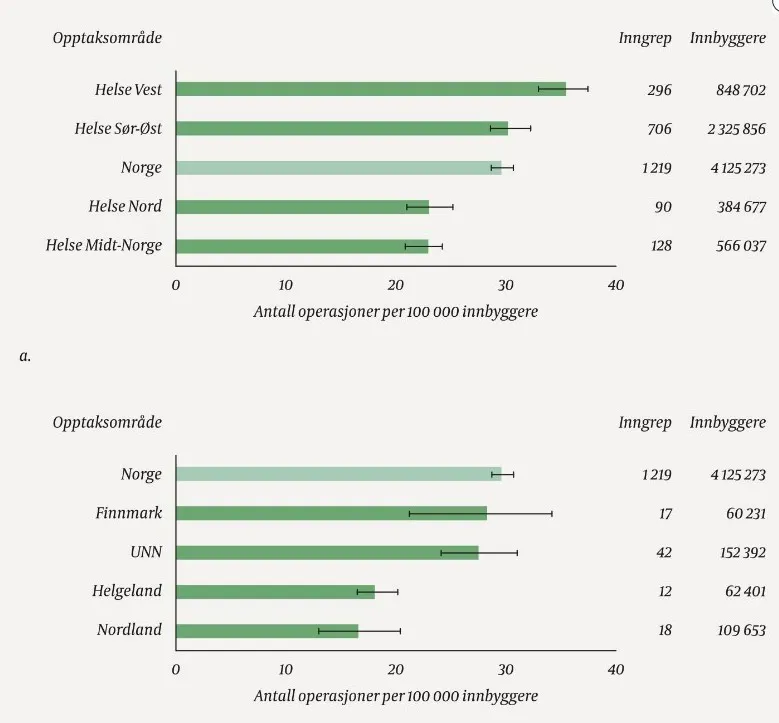
Photo: Arkiv
Self-coverage is a silver lining
The study also reveals that self-coverage in Health North was low in 2014 (69%). However, it increased to 91 per cent in 2018 due to approximately 30 more neck operations per year at UNN Tromsø.
— Would you describe self-coverage as a silver lining for Health North?
— Yes, self-coverage for neck surgery increased from 2014 to 2018, which is good. The increase is mainly due to a better day surgery offer. But it is paradoxical that the sickest patients and those needing the most complicated operations have to wait the longest, which is obviously not in line with the prioritisation regulations.
If self-coverage in the region is to reach the level of the national average, activity must increase by approximately 35 operations per year, is the conclusion of the researchers.
— For neck surgery, that should be sufficient. However, one should view neck and spine surgery as a combined offer, and our studies indicate that capacity must increase by approximately 200 operations per year. This means that the need is for a capacity increase of about one neck or spine operation per day at UNN Tromsø. One would think that this is manageable, believes Tor Ingebrigtsen.
Comparison with other health regions
Compared with other health regions, the study shows that Health North is slightly better off than Health Mid-Norway, but some way behind Health West and Health South-East.
-
The average treatment rate for residents in Health West was 35.5 operations per 100,000 inhabitants per year, which corresponds to 120 per cent of the national average.
-
The rate for residents in Health South-East at 30.2 operations per 100,000 inhabitants per year was very close to the national average.
-
For residents in Health Mid-Norway, the rate was 22.9 operations per 100,000 inhabitants per year. This corresponds to 78 per cent of the national average.
A common cause of health loss
Back and neck pain is the most common cause of non-fatal health loss and short-term sick leave, and the second most common reason for disability benefits. Degenerative, in a medical context, means deterioration, destruction, or change, and often occurs as a consequence of ageing.
— The most common issue is the entrapment of a nerve root to the arm due to a herniated disc or calcifications around the joints. This can cause severe radiating pain from the neck to the arms, and in some cases, serious muscle weakness. Most patients waiting for surgery have a severe pain problem of this type. Some patients also experience entrapment of the spinal cord itself. In such cases, all functions in both arms, legs, and the lower abdomen are threatened, and the patient is prioritised for urgent surgery, explains Professor Tor Ingebrigtsen.
FACTS
-
Data in the study is sourced from the Norwegian Patient Register (NPR) regarding hospital stays during the period 2014—18. The register does not include operations performed at private hospitals that patients have paid for themselves or through private health insurance.
-
The data extraction was carried out by the Centre for Clinical Documentation and Evaluation (SKDE) and is based on an algorithm validated by the National Quality Register for Spine Surgery.
-
The analysis covers the entire country but has focused on residents in Health North. This means in the catchment areas of Finnmark Hospital (Finnmark), University Hospital of North Norway (Troms and Ofoten), Nordland Hospital (Nordland), and Helgeland Hospital (Helgeland).