Overuse of MRI scans with little health benefit
Every year, one in ten Norwegians undergoes an outpatient MRI examination. In a new health atlas in radiology, SKDE finds that several of the examinations offer minimal health benefits and represent overconsumption.
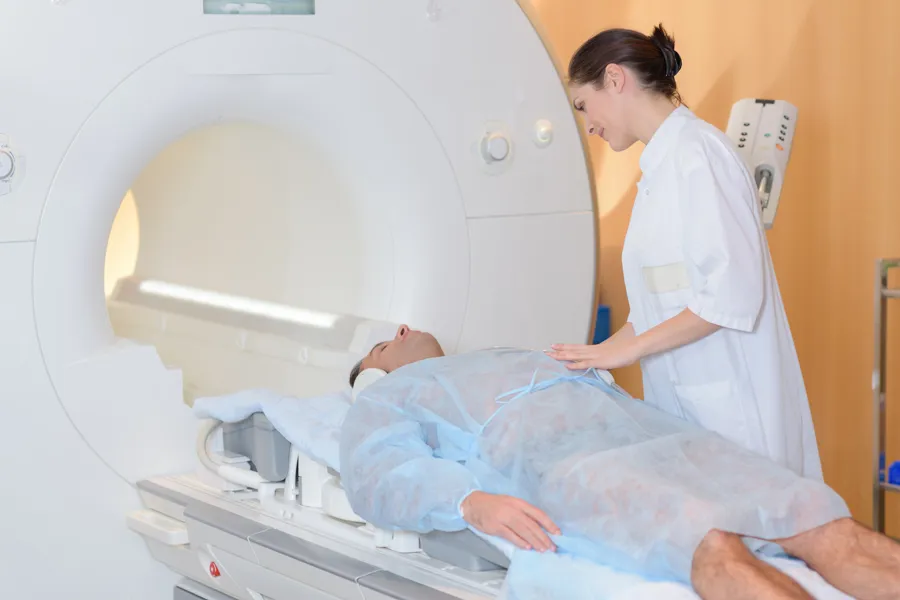
Photo: Colourbox
This shows a new health atlas in radiology prepared by the Centre for Clinical Documentation and Evaluation (SKDE), Health North.
Here you can see results from across the country.
Increase in Paid Refunds
Over the last five years, the number of outpatient MRI examinations in Norway has increased by five per cent. Paid refunds rose by 14 per cent during the same period, amounting to a total of 393 million kroner in 2022.
Annually, over half a million patients underwent outpatient MRI examinations during the period 2018—2022. Sixty-seven per cent of the examinations were conducted at private radiology clinics.
For residents in the catchment area* of Health Fonna HF, there are 40 per cent more MRI examinations per 10,000 inhabitants compared to the catchment area of Førde. If the use of MRI examinations across the country had been similar to that of residents in the catchment area of Health Førde HF, the paid refunds would have been reduced by 72 million kroner in one year.
Minimal Health Benefit
Regarding knee MRI examinations, the results show that from 2018—2022, there were annually 188 knee MRIs per 10,000 inhabitants over 50 years old for the country as a whole. This is despite the fact that knee MRIs for patients over 50 rarely provide information that alters the recommended treatment. Eight per cent of knee MRI examinations were followed by surgical intervention within a year.
— Few of the examinations have a clinical and treatment-related consequence. These examinations can therefore be considered to have minimal health benefit and represent overuse, says the analyst behind the health atlas project at SKDE, Tove Johansen.
The total amount of refunds paid in 2022 for knee MRI examinations for patients over 50 years old was 16.5 million kroner.
The majority of those who received outpatient shoulder MRIs were patients over 50 years old. A small proportion (1%) of the examinations for these patients were followed by shoulder prosthesis insertion or osteotomy within a year, while 10 per cent of the examinations were followed by other surgical interventions in the shoulder. Similar to knee MRIs, these examinations can be considered to have minimal health benefit and represent overuse. Total refunds in 2022 for these patients amounted to 15.8 million kroner.
Significant Geographical Variation
Geographical variation has also been found for prostate MRIs, where the highest rate (residents in the catchment area of Health Stavanger HF) is more than double that of the lowest (residents in the catchment area of Health Førde HF). Although suspicion of prostate cancer is the main indication for performing prostate MRIs, only 33 per cent of the examinations were conducted on patients who were in a care pathway for prostate cancer.
Most Women Receive Head MRIs
Annually, approximately 113,000 head MRI examinations were performed. This makes head MRI the most common MRI examination during the period. The most examinations were conducted for residents in the catchment area of Østfold Hospital HF, where 50 per cent more outpatient head MRIs were performed compared to the catchment area of Finnmark Hospital HF.
There were nearly twice as many women as men, particularly in the age group of 15—55 years, who underwent head MRIs. Some of the explanation is likely due to headaches and migraines, which occur more frequently in women.
About the Health Atlas
The health atlas for outpatient radiological examinations is divided into several parts, which are published separately. The first part will be published on 14 June and will cover the total number of MRI examinations from 2018—2022, as well as more detailed analyses of a selection of MRI examinations: head, shoulder, hand, prostate, and knee. Results for the use of pelvic MRI, hip MRI, neck/back MRI, and selected CT examinations are planned to be published at a later date.
* About the catchment area: Each health enterprise has a catchment area that includes specific municipalities and districts. Different specialties may have different catchment areas, and certain services are functionally distributed among various health enterprises and/or private providers. In the health atlases from SKDE, the catchment areas for specialist healthcare's emergency medical services are typically used.