We recommend that you upgrade to the latest version of your browser.
Significant variation in health services within addiction and psychiatry.
A new report from SKDE shows that there was significant variation within Helse Nord regarding the use of specialist healthcare services in the fields of addiction and psychiatry.
Published 2/27/2026
Photo: UNN Åsgård
A new report mapping the use of healthcare services within mental health care and substance abuse finds significant geographical differences within Health North, according to the Centre for Clinical Documentation and Evaluation (SKDE). Both the use of outpatient contacts, institutional stays, and the number of days spent in care vary depending on where the patients live.
Det var stor og uberettiget geografisk variasjon i bruk av polikliniske kontakter, institusjonsopphold og oppholdsdøgn både for pasienter i psykisk helsevern for voksne (PHV) og for pasienter i tverrfaglig spesialisert rusbehandling (TSB).
I PHV var variasjonen særlig stor for pasienter med alvorlige psykiske lidelser, noe som kan tyde på ulik prioritering av disse pasientene ved forskjellige behandlingssteder.
I motsetning til hva som er tilfelle for somatiske helsetjenester finner vi at unge voksne hadde betydelig høyere bruk av polikliniske kontakter og institusjonsopphold i PHV enn eldre.
Bruk av institusjonsopphold og oppholdsdøgn i PHV var høyere for bosatte i opptaksområdene UNN og Finnmark enn for bosatte i opptaksområdene Nordland og Helgeland. Resultatene tyder på at dette skyldes ulik kapasitet ved DPS-ene i UNN/Finnmarkssykehuset sammenliknet med Nordlandssykehuset/Helgelandssykehuset.
Andel opphold i PHV som gav opphav til en akutt reinnleggelse, varierte fra omlag 30 prosent ved Senter for psykisk helse og rusbehandling Tromsø, til 5 prosent ved Senter for psykisk helse og rus Mosjøen og DPS Øst-Finnmark.
However, it is difficult to determine how much of the variation is due to differences in the prevalence of mental disorders or differing divisions of labour between specialist and primary healthcare services, and how much is due to differing professional practices within specialist healthcare. Knowledge of how the prevalence of mental illness varies geographically in Norway is lacking. Studies from other countries make it reasonable to assume that the prevalence of mental illness also varies geographically in Norway, but it remains uncertain whether the morbidity within Northern Norway varies and, if so, how significant this variation is.
The proportion of the population that has been in contact with specialist healthcare due to a severe mental disorder varies more than expected. Whether this variation is due to differing prevalence or other factors cannot be assessed based on the data available for this report.
Yet unjustified variation
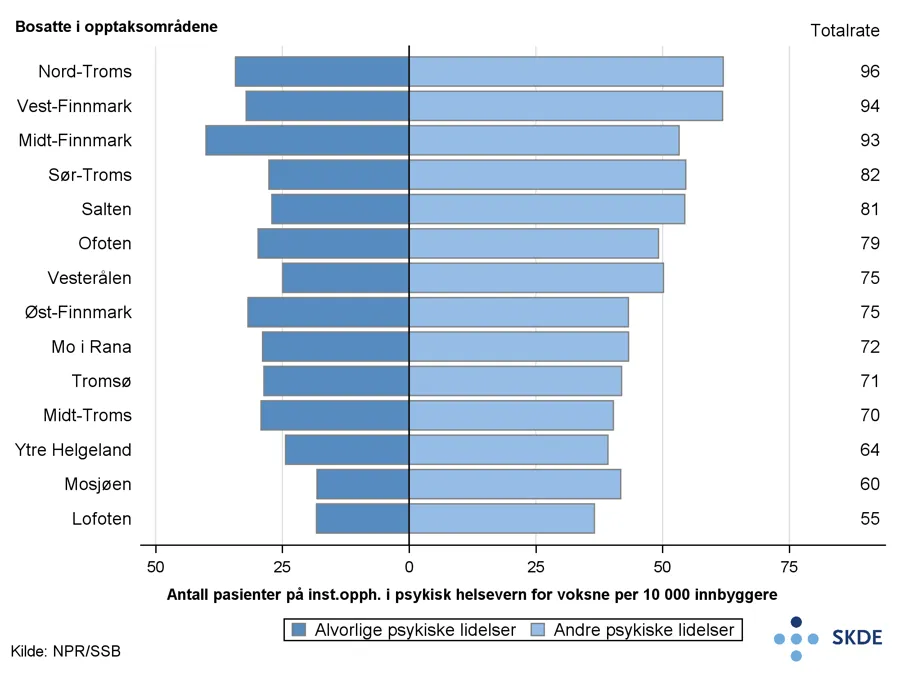
However, the differences in service usage were so significant that they cannot be explained by the varying proportion of the population receiving treatment in specialist healthcare, as illustrated in the figures below. This is why the variation in service usage is considered unjustified, despite the lack of knowledge about geographical differences in prevalence.
Photo: SKDE
Figur 1: Pasienter med institusjonsopphold i psykisk helsevern for voksne
The number of patients with institutional stays in adult mental health care per 10,000 inhabitants, adjusted for gender and age, and divided into patients with severe mental disorders and patients with other mental disorders. Average per year for the period 2015–2017. The figure shows that nearly twice as many residents in North Troms received inpatient treatment compared to residents in Lofoten.
Photo: SKDE
Figur 2: Oppholdsdøgn i psykisk helsevern for voksne
The number of inpatient days in mental health care per 10,000 inhabitants, adjusted for gender and age, and divided into patients with severe mental disorders and patients with other mental disorders. Average per year for the period 2015–2017. The figure shows that residents in West Finnmark had over twice as many inpatient days per 10,000 inhabitants compared to residents in Mosjøen.
Need for mapping
Mapping the prevalence of various types of mental illness in Norway and how this varies geographically should be a priority area for further studies, as knowledge of this is crucial for assessing the extent and variation in the use of services within mental health care.
New national medical quality registers planned in this field have the potential to illuminate both the need for healthcare services in the population and variation in professional practice. This will be very important for further work to document the causes of and consequences of observed geographical variation within mental health care.