Fresh themed issue on medical quality registers
The latest edition of the Journal of the Norwegian Association for Epidemiology is dedicated to medical quality registers in Norway.
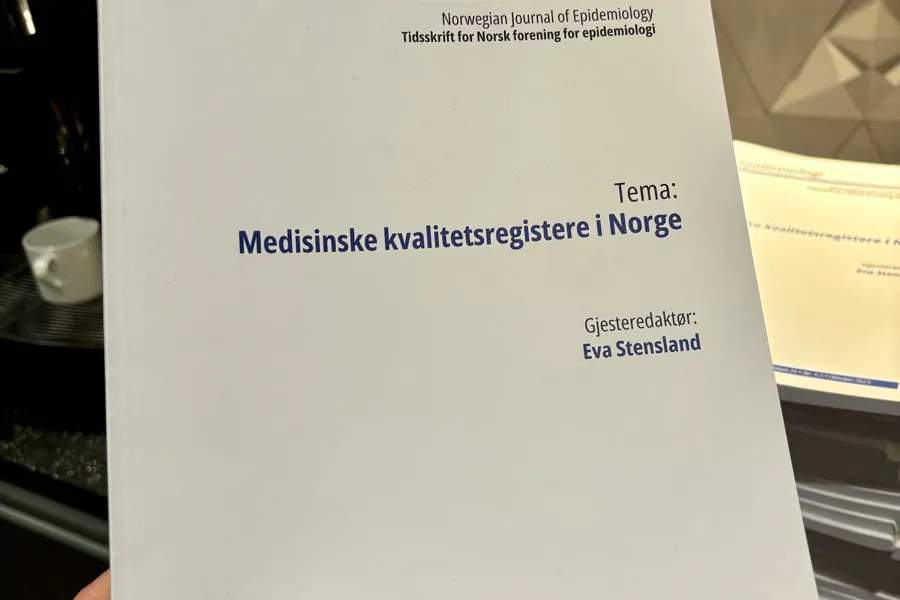
The issue contains 19 articles on medical quality registers and the work being done to contribute to better quality in patient care and reduce unwarranted variation in health services and treatment quality.
Many Contributors
Among the contributors are the MS Register, the Norwegian Quality and Follow-up Register for Cerebral Palsy, the Norwegian Cardiac Arrest Register, the Norwegian Diabetes Register for Adults, the Norwegian Register for Anal Incontinence, the National Register for Gastrointestinal Surgery, the Norwegian Parkinson's Register and Biobank, the Norwegian Spinal Cord Injury Register, the National Register for Joint Prostheses, the National Hip Fracture Register, the National Cruciate Ligament Register, the National Register for Children's Hips, the National Quality Register for Melanoma, the Norwegian Stroke Register, the National Medical Quality Register for Treatment in Adult Mental Health Services, the National Quality Register for Child and Adolescent Mental Health Services, the Norwegian Quality Register for the Treatment of Eating Disorders, the National ECT Register, the National Quality Register for the Treatment of Harmful Use or Dependence on Substances, the Norwegian Intensive and Pandemic Register, the Norwegian Female Incontinence Register, the Register for Organ-Specific Autoimmune Diseases, and the Norwegian Heart Failure Register.
Sharing Positive and Negative Experiences
The topics addressed include the usefulness of medical quality registers from a leadership perspective, methods and research results, as well as both positive and negative experiences that the registers have encountered after many years of existence.
For approximately 20 years, the Norwegian Quality and Follow-up Register for Cerebral Palsy (NorCP) has systematically collected data on individuals with cerebral palsy and has been a driving force for knowledge dissemination. This is stated by Sandra Julsen Hollung, Reidun Jahnsen, Gunvor Lilleholt Klevberg, Nina Kløve, and Guro L. Andersen. During this time, data from NorCP has contributed to enhancing the competence of healthcare professionals through the publication of several scientific articles. "This has led to improved quality in the diagnosis and follow-up of children and young people with CP in Norway, ensuring that they receive 'the right treatment at the right time', regardless of where they live in the country (...)," they write.
Another register sharing its experiences after 10 years is the National Register for Gastrointestinal Surgery (NORGAST), by Stig Norderval, Kjerstin Havnes, and Kristoffer Lassen. They write that it is still uncertain to what extent the register is used as intended. They emphasise that it is "unthinkable to run a surgical department without having a complete overview of adequate, central indicators of quality." Nevertheless, they have continually been surprised that many at the management level are not sufficiently aware of the quality of the work being done in their department or hospital. "In 2023, there are still three hospitals in Norway with management that comfortably operates without the faintest idea of what kind of gastrointestinal surgical quality they are delivering," they write.
Eager to Contribute
The Centre for Clinical Documentation and Evaluation agreed to contribute to the journal in spring 2022, with guest editor Eva Stensland, Head of Professional and Research Affairs and incoming Director at SKDE.
— Of course we wanted to contribute! It is a very good opportunity to showcase the excellent work being done in the registers across the country, says Stensland, who explains that the National Service Environment sent inquiries to all the national medical quality registers asking if they wished to contribute an article to the themed issue.
Here is the link to the latest issue of the Journal of the Norwegian Association for Epidemiology.
FAKTA om medisinske kvalitetsregistre i Norge
- Det er 59 nasjonale medisinske kvalitetsregistre i Norge med nasjonal status.
- Et medisinsk kvalitetsregister samler strukturert informasjon fra behandlingsforløp for pasienter innenfor definert sykdomsgrupper, for eksempel hjertesvikt, hjerneslag og diabetes.
- Alle kvalitetsregistrene har samme målsetting: Å bidra til at kvaliteten i diagnostikk, behandling og oppfølging av pasienter blir stadig bedre.
- Kvalitetsregistrene er viktige fordi de både fremskaffer ny, viktig kunnskap gjennom analyse og forskning, og er pådrivere for å bruke resultatene aktivt i klinisk forbedringsarbeid.